
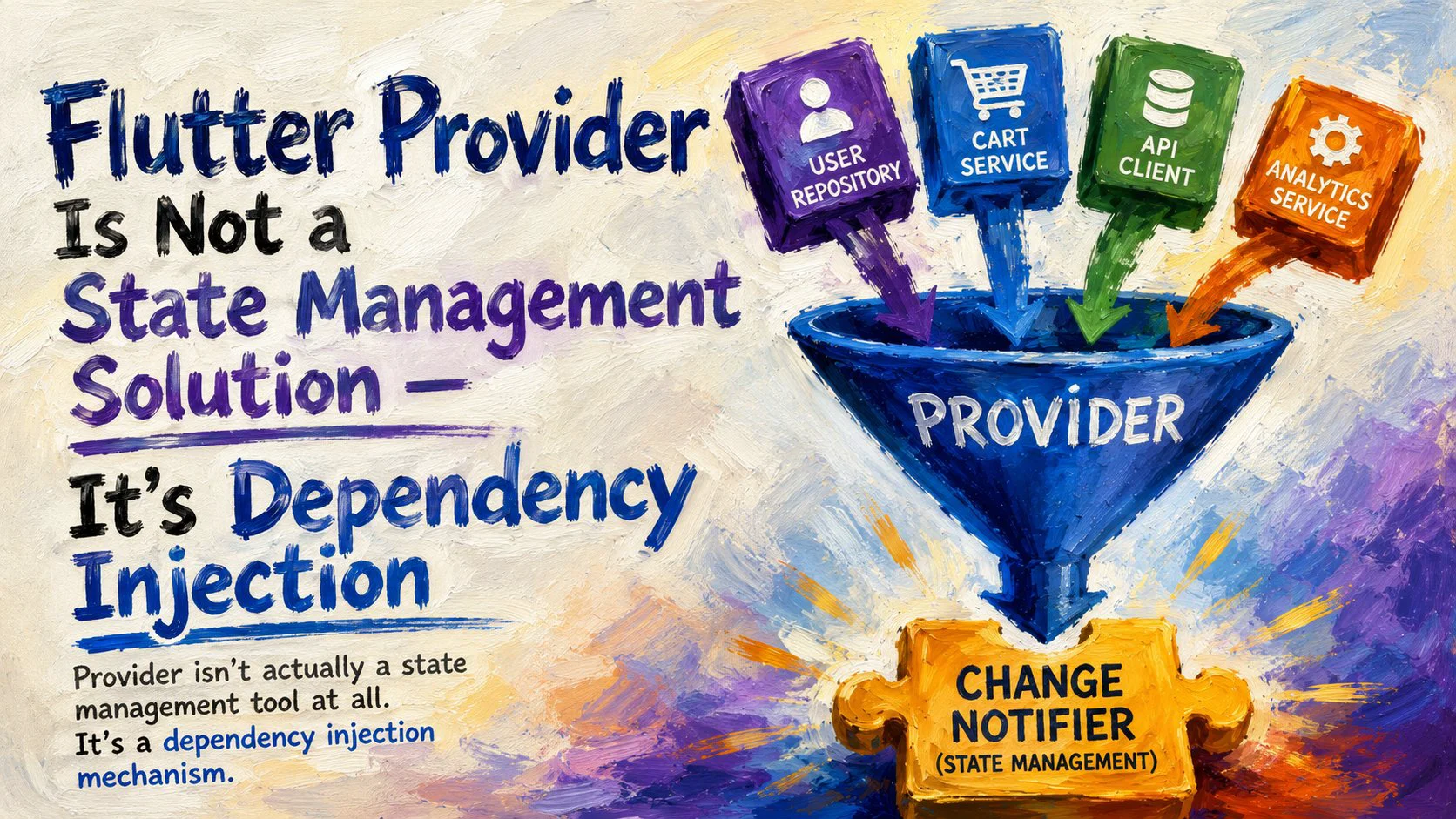
If you've spent any time in the Flutter community, you've probably heard Provider described as "the recommended state management solution." This framing has become so common that most developers accept it without question. But I want to challenge this idea: Provider isn't actually a state management tool at all. It's a dependency injection mechanism. The real state management work is being done by ChangeNotifier.
Understanding this distinction will fundamentally change how you architect your Flutter applications.
The Common Misconception
Walk into any Flutter codebase, and you'll likely see something like this:
ChangeNotifierProvider(
  create: (_) => CounterModel(),
  child: MyApp(),
)
Ask the developer what's managing state here, and they'll probably say "Provider." But look closer. What's actually holding the state? What's notifying listeners when that state changes? It's not Provider — it's ChangeNotifier.
Provider is just the delivery truck. ChangeNotifier is the actual product.
What Provider Actually Does
Provider's job is straightforward and narrow: it makes objects available to widgets in the widget tree below it. That's dependency injection. It's the same concept you'd find in Angular's DI system, Spring's IoC container, or Dagger in Android development — just adapted for Flutter's widget tree.
Here's what Provider gives you:
// Provider injects MyService into the widget tree
Provider<MyService>(
  create: (_) => MyService(),
  child: MyApp(),
)

// Anywhere below, widgets can access it
final service = Provider.of<MyService>(context);
// Or with the more modern API
final service = context.read<MyService>();
Notice something? MyService here doesn't need to be stateful. It doesn't need to notify anyone. It could be an HTTP client, a logger, a configuration object, or any plain Dart class. Provider doesn't care — it just delivers it where you need it.
This is dependency injection, plain and simple. You're declaring "I want this object to be available in this part of my widget tree" and Provider handles the lookup and lifecycle management.
Where the Actual State Management Happens
The moment you reach for ChangeNotifierProvider, you've stepped outside Provider's core functionality and into Flutter's built-in state management primitives. ChangeNotifier is part of the Flutter framework itself, living in the foundation library — not in the Provider package.
Let's look at a typical "Provider state management" example:
class CounterModel extends ChangeNotifier {
  int _count = 0;
  int get count => _count;

  void increment() {
    _count++;
    notifyListeners(); // ← This is the actual state management
  }
}
The state lives in _count. The mechanism for telling the UI "hey, something changed" is notifyListeners(). The pattern of observing changes and rebuilding is the Observer pattern, implemented by ChangeNotifier.
Provider's role in this picture? It just makes sure your widgets can find this ChangeNotifier instance. That's it.
You could replace Provider with InheritedWidget, GetIt, or even pass the ChangeNotifier down manually through constructors, and your state management would work exactly the same way. The state logic doesn't change because Provider isn't doing the state management.
A Demonstration: Provider Without State Management
To prove the point, here's Provider being genuinely useful without any state management at all:
class ApiClient {
  final String baseUrl;
  ApiClient(this.baseUrl);

  Future<User> fetchUser(int id) async {
    // ... HTTP call logic
  }
}

void main() {
  runApp(
    Provider<ApiClient>(
      create: (_) => ApiClient('https://api.example.com'),
      child: MyApp(),
    ),
  );
}
ApiClient has no state, no listeners, no notifications. But Provider is still incredibly valuable here — it gives every widget in the tree access to a single, consistent instance of ApiClient. This is textbook dependency injection.
And State Management Without Provider
Conversely, here's ChangeNotifier doing real state management without Provider anywhere in sight:
class CounterScreen extends StatefulWidget {
  @override
  State<CounterScreen> createState() => _CounterScreenState();
}

class _CounterScreenState extends State<CounterScreen> {
  final counter = CounterModel();

  @override
  void initState() {
    super.initState();
    counter.addListener(_onChange);
  }

  void _onChange() => setState(() {});

  @override
  void dispose() {
    counter.removeListener(_onChange);
    counter.dispose();
    super.dispose();
  }

  @override
  Widget build(BuildContext context) {
    return Text('${counter.count}');
  }
}
State is being managed. Listeners are being notified. UI is rebuilding. No Provider involved. The state management is fully handled by ChangeNotifier.
Why This Distinction Matters
You might be thinking: "Okay, semantic nitpicking. Why does this matter in practice?" It matters for several real reasons.
It clarifies your architecture. When you understand that Provider is DI and ChangeNotifier is state management, you start making cleaner architectural choices. You can use Provider to inject services, repositories, and use cases that aren't stateful. You stop conflating "I need to share this object" with "I need state management."
It opens up better tool selection. Once you separate these concerns, you realize you can mix and match. Use Provider for DI and pair it with ValueNotifier, Stream, Riverpod, BLoC, or any other state management approach. They're not competitors with Provider — they're complements or alternatives to ChangeNotifier.
It explains Provider's limitations. People often complain that Provider "doesn't scale" or "gets messy in large apps." But these complaints usually aren't about Provider — they're about ChangeNotifier. ChangeNotifier has real limitations: it's mutable, it lacks fine-grained reactivity, and it can encourage bloated model classes. When you understand the separation, you realize the solution isn't to abandon Provider, but to swap out ChangeNotifier for something better suited to your needs.
It informs migration paths. Teams considering moving from Provider to Riverpod often think they're swapping state management solutions. They're not — they're swapping both DI and state management simultaneously, because Riverpod handles both. Understanding what each piece does makes the migration clearer and more intentional.
The Provider Package's Own Documentation
If you read the Provider package documentation carefully, the author Remi Rousselet has actually been clear about this. Provider is described as a wrapper around InheritedWidget to make them more reusable. It's about exposing values down the widget tree — that's dependency injection. The state management classes (ChangeNotifier, ValueNotifier, streams) are separate concepts that Provider knows how to integrate with through specialized providers like ChangeNotifierProvider and StreamProvider.
The convenience of ChangeNotifierProvider has just been so successful that people conflated the two roles.
A Cleaner Mental Model
Here's how I'd encourage you to think about it going forward. Provider answers the question "how do I get this object to the widgets that need it?" That's a dependency injection question. ChangeNotifier, ValueNotifier, streams, and other reactive primitives answer the question "how do I notify the UI when something changes?" That's a state management question.
Most apps need answers to both questions, which is why Provider and ChangeNotifier are so often used together. But they're solving different problems, and treating them as a single concept obscures what's actually happening in your code.
Closing Thoughts
Next time you reach for ChangeNotifierProvider, take a moment to appreciate what each piece is doing. Provider is gracefully handling the dependency injection — making sure your widgets can access the model without prop-drilling through constructors. ChangeNotifier is doing the actual state management — holding values, accepting mutations, and notifying observers when things change.
This isn't just academic. Once this distinction clicks, you'll find yourself writing cleaner code, choosing better tools for specific jobs, and having more productive conversations about Flutter architecture. You'll stop asking "should I use Provider or BLoC?" — a category-confused question — and start asking "how do I want to manage state, and how do I want to inject dependencies?" Two separate decisions, two appropriate tools.
Provider is excellent at what it actually does. We just need to be honest about what that is.
Happy Coding : )
Loading…